Best Decagon Alternatives in 2026: Pricing and Fit
Decagon is an enterprise AI customer support agent with no public rate card. Here are the best alternatives, what Decagon actually publishes about pricing, and when a self-serve inbox is the better fit.
The best Decagon alternative depends on whether you wanted an enterprise AI agent, or a help desk with AI inside it. Pick Sierra if you still want a contracted enterprise agent and you prefer outcome-based billing. Pick SupportWire if you want a public monthly price, a human inbox, and AI billed only when Kal closes a ticket. Stay with Decagon if you are buying a high-volume enterprise agent and you are ready to negotiate per-conversation or per-resolution rates.
Updated 27 Nov 2026. Decagon and Sierra publish no list prices. SupportWire prices were checked on our pricing page that day. No third-party Decagon estimates are used as prices below.
Decagon and Sierra do not publish a rate card. Decagon quotes per conversation or per resolution. Sierra quotes outcome-based pricing, with a blended per-conversation option for greeter-style work. This widget only prices SupportWire, which is public: $19 per seat and $0.49 per Kal close after 50 included. Checked 27 Nov 2026.
- SupportWire $119.50
5 × $19 seats ($95) + 50 AI closes × $0.49
- Decagon Custom quote
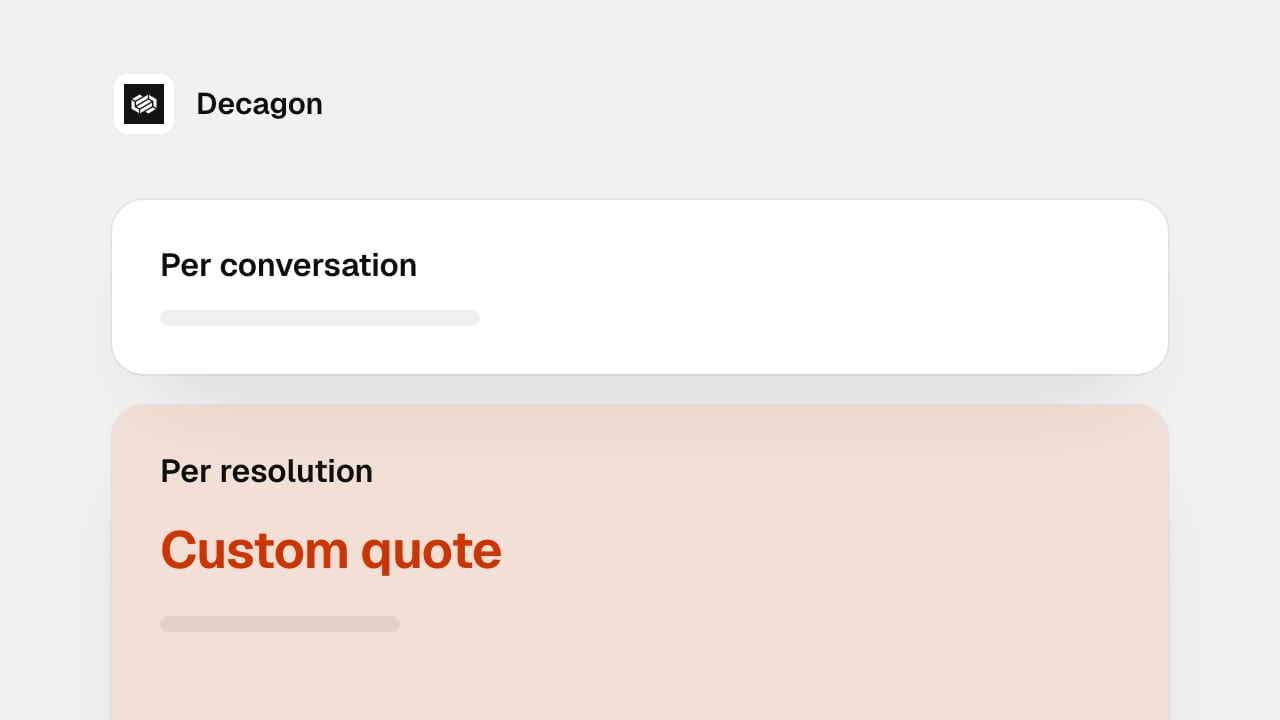
Custom quote, per conversation or per resolution
Decagon does not publish a rate card. It says most customers pick per-conversation pricing, and per-resolution quotes do not charge escalations.
- Sierra Custom quote
Custom quote, outcome-based in most cases
Sierra does not publish a rate card. Unresolved conversations usually are not billed. Routing or greeter work may use a blended per-conversation rate.
Decagon vs the alternatives at a glance#
| Tool | Published starting price | How AI is billed | Native phone | Best when |
|---|---|---|---|---|
| Decagon | Custom quote. No public rate card | Per conversation or per resolution, quoted | Not published as a self-serve plan | Enterprise AI agent programs |
| Sierra | Custom quote. No public rate card | Outcome-based in most cases, blended per conversation for greeter work | Not published as a self-serve plan | Enterprise CX agents paid on agreed outcomes |
| SupportWire | $19 / seat / mo, monthly | 50 closes included, then $0.49 on a close | No | Self-serve inbox, predictable AI |
| Zendesk Suite plus AI | Suite Team is $55 / agent / mo, annual | 5 automated resolutions per agent / mo, then $2.00 pay-as-you-go | Included on Suite, usage extra | You already live in Zendesk |
| Forethought | Team, Professional, and Enterprise are all custom quotes | Platform fee plus an outcome-based cost | Voice is listed on Professional and Enterprise | Zendesk-adjacent AI agents, or a standalone quote |
There is no honest dollar column for Decagon or Sierra. If a vendor did not publish a number, this table does not invent one.
What Decagon actually is#
Decagon sells AI agents that resolve customer service conversations for enterprise teams. Its own materials describe agents measured on resolution rate and CSAT, with deployments aimed at high-volume programs rather than a self-serve inbox for a small team. In a 2026 product post, Decagon says it is currently optimized for enterprise buyers and does not offer a self-serve product for SMB buyers.
It is not a classic help desk that you roll out in an afternoon. Human agents, the existing ticketing system, and a deployment team are part of the usual picture. If you came here looking for a seat-based desk with a published price, Decagon is a different category.
What Decagon publishes about pricing#
Checked 27 Nov 2026, Decagon does not list plan names or dollar figures on a pricing page. The first-party source is Pricing the AI Agent Economy, dated 10 Dec 2024. In that post, Decagon describes two models:
- Per-conversation pricing: a fixed rate for every incoming conversation, with flexible pricing at higher volumes.
- Per-resolution pricing: a higher fixed rate for each fully resolved conversation, with no charge for escalations. Larger resolution commitments lower the rate.
Decagon says the majority of customers choose per-conversation pricing, and it argues that this avoids disputes over what counts as a resolved conversation. That is a model description, not a quote. There is still no public rate, minimum, or platform fee on Decagon's own pages.
Some directories and competitor blogs publish dollar guesses. Those are not Decagon list prices, so they are omitted here.
Decagon vs Sierra#
This is the comparison most enterprise buyers actually run. Both are custom-quoted. Both are built as AI agents, not as $19-per-seat inboxes.
The published difference is the bill. Decagon lets you choose per conversation or per resolution, and says most customers pick per conversation so they are not arguing over outcomes. Sierra leads with outcome-based pricing: you pay when an agreed outcome is met, such as a resolved support conversation, a saved cancellation, or an upsell, and unresolved work usually is not billed. Sierra also says greeter or routing interactions may use a blended per-conversation rate.
If you want that full write-up from Sierra's side, see Best Sierra alternatives. Neither article can tell you which contract is cheaper. That only shows up in a quote.
When Decagon is the better pick#
Stay with Decagon if you are an enterprise team buying an AI agent to take a large share of conversations, you want a per-conversation or per-resolution contract, and you have the budget and patience for a sales-led rollout. Stay also if you have already compared Sierra and prefer Decagon's stance on not billing "outcomes" that can be disputed.
When SupportWire is the better pick#
Pick SupportWire if the thing you actually needed was a help desk: a human inbox, a knowledge base, and an AI agent you can turn on without a custom contract. SupportWire is $19 per seat per month. Lite seats are free. Kal includes 50 closes a month, then $0.49 per close.
Be honest about the gap. SupportWire is not a drop-in replacement for a contracted enterprise agent program, and it has no native phone channel. If your requirement is a dedicated agent platform with a professional services team and a volume commitment, Decagon or Sierra is still the category you are shopping.
The 6 best Decagon alternatives#
1. Sierra
The closest peer. Custom quote, outcome-based in most cases, enterprise CX agents, no public rate card. Better when you want to pay for agreed outcomes and you are buying in the same enterprise category. Worse when you wanted a public price. Details in Best Sierra alternatives.
2. SupportWire
A self-serve inbox with published monthly pricing and AI billed on a close. Better when you want to start without a sales process and you can live without native phone. Worse when you need a high-volume enterprise agent with a custom contract.
3. Forethought, now sold by Zendesk
Forethought still has a pricing page with Team, Professional, and Enterprise tiers, but every tier is a quote. Zendesk completed the acquisition on 26 Mar 2026 and began selling Forethought as a Zendesk add-on on 4 Jun 2026. Better when you already use Zendesk and want an official add-on path. Worse when you wanted to get away from the Zendesk stack.
4. Zendesk AI on Zendesk Suite
If you already pay for Zendesk, the published automated-resolution rates may be enough. Zendesk pricing walks through Suite Team at $55 per agent per month annually, with 5 automated resolutions per agent included and $2.00 pay-as-you-go after that. Better when telephony and the Zendesk marketplace matter. Worse when you wanted a specialist enterprise agent unbundled from a Suite seat bill.
5. Intercom Fin
A widely deployed AI agent with a different public price shape than Decagon's unpublished quotes. See Intercom pricing explained and Best Intercom alternatives for startups. Better when you already run Intercom. Worse when you were specifically buying an enterprise agent like Decagon or Sierra.
6. A classic help desk with lighter AI
If the enterprise agent pitch is more than you need, a desk such as Freshdesk, Chatwoot, or LiveAgent may be enough. Better when tickets and a human team are the center of the job. Worse when autonomous resolution at enterprise volume is why you looked at Decagon.
Moving from Decagon to SupportWire#
There is no one-click Decagon importer on SupportWire's migration page. If you leave an enterprise agent, plan for the human inbox, the knowledge you already tuned, and any voice or messaging channels that sat next to Decagon. Export what you can, load docs into the Knowledge Store, rebuild automations, and run in parallel before you cut over. The same sequence we use for Zendesk is in How to switch from Zendesk.
So which one should you pick?#
Pick Decagon if you are buying an enterprise AI agent and you want a per-conversation or per-resolution contract. Pick Sierra if you want that same category with outcome-based billing. Pick Forethought if you are already on Zendesk and want the official add-on. Pick SupportWire if you want $19 seats, free lite seats, and $0.49 only when Kal closes the ticket.
Current SupportWire rates are on the pricing page.
Frequently asked questions
It depends on the job. If you need another enterprise AI agent with a services-led rollout, Sierra is the usual comparison, also with no public rate card. If you want a self-serve inbox plus AI billed only when a ticket closes, SupportWire is $19 per seat per month, unlimited free lite seats, and $0.49 per Kal close after 50 included each month. Decagon remains the better pick for a high-volume enterprise agent program with a custom contract. Checked 27 Nov 2026.
Decagon does not publish a rate card. Checked 27 Nov 2026, there is no public pricing page with dollar figures. Decagon's own post, "Pricing the AI Agent Economy," describes two custom-quoted models: a fixed rate per incoming conversation, or a higher rate per fully resolved conversation with no charge for escalations. It says the majority of customers choose per-conversation pricing. Third-party estimates circulate online. They are not confirmed by Decagon, so they are not used as prices in this article.
Both sell enterprise AI agents on custom contracts and publish no sticker prices. Decagon offers per-conversation or per-resolution billing, and says most customers pick per-conversation in part to avoid disputes over what counts as a resolution. Sierra leads with outcome-based pricing, where you pay when an agreed outcome is met, and says unresolved conversations usually are not billed. Sierra also offers a blended per-conversation rate for greeter or routing work. See Best Sierra alternatives.
Not for every team. Decagon is an enterprise AI agent platform with a sales and deployment motion, and no self-serve product for small buyers, by its own positioning. SupportWire is a help desk with an AI agent, a public monthly price, and no native phone channel. Choose SupportWire if you want a human inbox plus metered AI you can start without a custom quote. Stay with Decagon if you need a dedicated enterprise agent program and you are ready to negotiate a contract.
No. The 10 Dec 2024 product post describes the two models and volume flexibility, but it does not name a dollar rate, a platform fee, or a minimum. This article does not fill that gap with competitor or marketplace guesses.
Stay if you want an enterprise AI agent to resolve a large share of customer conversations, you are comfortable with a custom quote, and you prefer Decagon's per-conversation or per-resolution models over Sierra's outcome-based contract. Move if you wanted a public price, a self-serve inbox for human agents, or you are not buying an enterprise agent platform.
Updated November 2026